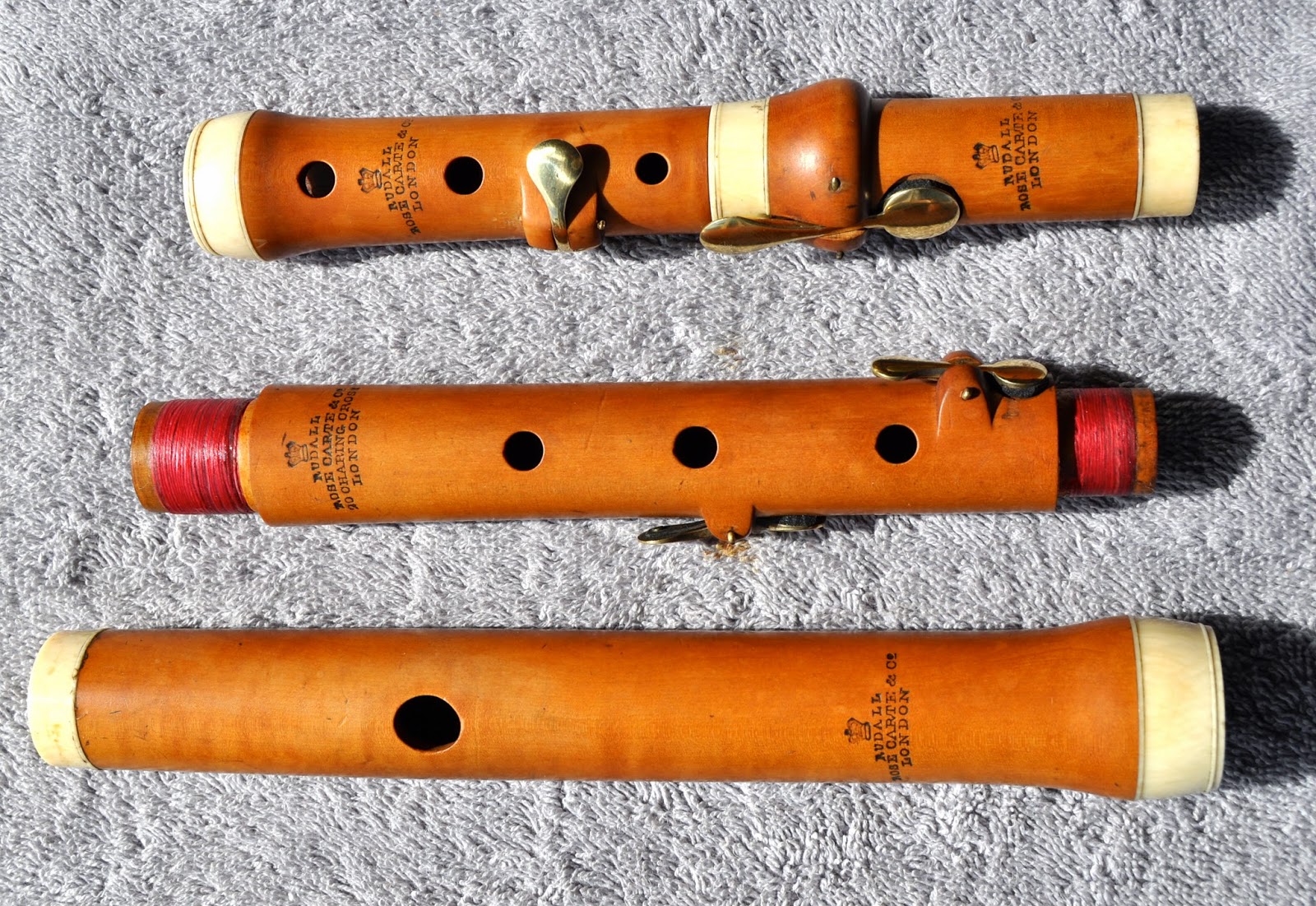
Wednesday, 19 October 2016

Abject Apologies!

I've just realised that it's February since I last posted here, so apologies to my readers. I could make the excuse that I've just been too busy, but since that applies all the time, it wouldn't really be a valid one.
At the end of this month I'm going to Portugal to the 5th Congresso Organologia to give a paper on:
The Irish Flute - A Recent Development in the Evolution of the Simple System Flute.

 You might question the "recent", but consider that the last attempts to improve the wooden 8 keyed flute were the attempts made in response to the Boehm flute by the likes of Siccama, Pratten and their ilk, around the middle of the 19th century.
As part of this I'm attempting to explain how modern makers began to adjust the pitch and internal tuning of their flutes in comparison to the exact copies that were made initially, and decided that the best way to do this was to use the RTTA tuning app to allow people to make a visual comparison between the 19th century instruments and modern ones.
I thought the results were quite striking, so I'm sharing it here.

First up, is the RTTA result for Rudall Rose & Carte 6318, which was tuned to a440, using the A in the lower octave as the reference point


For those not familiar with this app, see my previous post on this topic. It's a fantastic resource, and just to recap, notes in green are within 10 cents of pitch, those in yellow from 10-20, and those in red, more than 20.
Now we all know that the tuning of the cone bore flute is far from perfect, and that in practical terms anything within 10 cents is workable, but as you can see this is horrific.
Remember that musically this sort of tuning was considered quite acceptable, and that the above record comes from an experienced player who has been playing this flute for almost 40 years ( me...)

Now here's the same thing played on the same occasion on a flute that I made a few years ago.


A good improvement, you'll have to admit, and the flute was tuned to a440 using the G in the lower octave as the tonal centre. The C# is still out, but that's cone bore flutes for you, and would be correct if I bothered to use the long C.

And so to finish.
Good flute makers never stop trying to improve their instruments. That's the challenge. That's what makes it interesting. I made a few tweaks to my design in the last year or so, and did so mainly with regard to tone and response, but here's the tuning result for it.


not happy yet though....

Wednesday, 17 February 2016

Dante's Satan....

I've been thinking about this concept for quite a while now, but, as always, getting around to doing something about it is rather more difficult. In fact I had this head made and working last August, and have meant to post about it since.
It's common knowledge that different types of embouchure,( and here I refer to the embouchure on the flute, that you blow into...or across, or into and across...that's a discussion for a different day)
suit different players, but if you're looking at a flute from this point of view and then comparing it with another, the problem is that you can't isolate just the embouchure. For example if you tried to compare embouchures across series of flutes, even those by the same maker, many other factors apart from the embouchure are changing, making comparisons of little value.
So the idea was to have a head which could stay on the same flute, but which would have interchangeable embouchures. Simpler to explain in pictures......


So essentially I took a length of head tubing, and milled a large squarish hole in it, centred on where the embouchure would normally be drilled.
Next I prepared three tubes of delrin, as you can see above. You might think that the upper and lower ones are superfluous, and in fact the head would work fine without them, but what you'd have then would be essentially a thinned head, and would give a different sound, not attributable to the different  embouchures. It's the middle piece that's the crux of the thing, and I'll have to explain a bit about that since it's impossible to show it effectively in one photo.
 What I did was to carefully machine this section so that it could rotate on the tube. I then cut three different embouchures separated at 120 degrees.
When the whole thing is assembled, it looks just like a normal head.


It also plays like a normal head...to a great extent. The fact that delrin is denser than blackwood, that the head is essentially  lined as opposed to unlined, and that there is a very minimal bore distortion, due to the inner edge of the tube not meeting the inner edge of the embouchure, will have a minor effect.
Here's a close up of the three embouchures on this particular middle section.
I've put a piece of white paper in the bore to make them easier to see.


In fact, although these might not seem so different when looked at from this point of view, what you can't see is the undercut on each embouchure which is where a lot of the significant difference lies.

Of course, because the middle section can be replaced with others, the amount of options open for testing a particular embouchure against a particular bore is almost unlimited.

By the way, the reason for the title of this blog is that in Dante's inferno, satan has a head with three mouths. He might have found this head handy...

Sunday, 17 January 2016

Ath Bhliain Faoi Mhaise Díbh Go Leir

Well, I'd intended to do a series of posts over Xmas, but now I'm having to wish you all a Happy New Year instead.
       Recently, I've been putting a lot of work into our Cruinniú na bhFliúit festival, the more so since we got a nasty surprise just before Xmas in the form of a letter from the Arts Council, informing us that they were cutting our grant to zero, zilch, nada, faic!
However we're pushing on ahead and have launched the festival for this year - details and registration over on the webpage
      We weren't the only ones to suffer, and if you're interested there was an interesting article in The Journal of Music about these cuts, which in fact have caused a bit of a stir, as they seem to be targeting festivals which are traditional music based.
      One thing we did to try to promote Cruinniú na bhFliúit was to make a short film which shows what we do at the Cruinniú, and hopefully puts across something of the wonderful atmosphere of the event. See it here
I'd appreciate it if readers could pass on the Cruinniú links, as we really need a high level of registrations this year in light of funding cuts.

While we're on the subject of videos, someone sent me a link to the RTE archives  of what I think was the very first piece of film ever shot in my workshop.
I think the flute that I was demonstrating and playing was the very first flute I ever made!
Note how I have not aged at all since 1980...as long as I keep my cap on...

Anyway, now that I've broken the ice for 2016, hopefully more flutey posts coming soon.

Sunday, 30 August 2015

To Coin a Fraise.....

Fraises are the little tools that wind instrument makers use to undercut the tone holes, thus making them wider where they meet the bore. Undercutting the holes has several functions, including modifying the tuning, and also the response of the note produced by that hole.
They are basically like tiny reamers, but they have to operate from inside the flute.
They are passed up the bore and lined up underneath the hole to be undercut. I use a wooden dowel with a tiny magnet in the end to do this. Then a T shaped handle is screwed into the threaded bore in the fraise, and this allows the tool to be pulled up into the tone hole and rotated. The thread is cut so that the direction of cut also tightens the handle in the fraise. With sufficient material removed, the handle is removed by pulling up hard into the hole and snappily reversing the direction of rotation. The fraise is then tapped free and falls back into the bore.

Here's a few pics of the manufacture.
The process requires an engineering lathe, and a milling machine with a dividing head. The threaded bore and basic taper of the tool are produced on the lathe, and then the flutes are cut on the milling machine, using the dividing head to ensure even division of the flutes. The image below shows the flute cutting, in this case at intervals of 30 deg. giving 12 flutes. ( I should point out here, to avoid confusion that the grooves in a drill or reamer are called flutes )

Since the tone holes on flutes are a variety of different sizes, this necessitates a variety of fraises, in different sizes and tapers to produce the desired result.
Here's three that I made last weekend...


Two interesting facts about the fraise. They are fiddly little buggers to make and fraise is the french for strawberry...


Monday, 10 August 2015

Coil Springs

Bit embarrassing, really. The last post about the square R & R did bring responses via E-Mail, where it was pointed out to me that this type of flute is really quite common, and was part of a large series of flutes that R & R made for the band market.
I have two excuses though.
 Firstly, all the boxwood band flutes that I'd previously seen had been stamped Key, Rudall & Co.
Around 1855-56, Rudall & Rose bought the band instrument firm of Thomas Key, and traded as Key Rudall, & Co., then Key, Rudall, Rose Carte & Co. and eventually just as Rudall, Rose, Carte & Co.
I hadn't realised that they eventually dropped Key's name.
Secondly, the ones I'd seen with the Key, Rudall stamp were of an inferior manufacture. This flute was really rather nice.
So sorry for misleading my readers!

I haven't been blogging for a while, partly because I got a back injury which kept me out of the workshop for a few weeks earlier in the summer and then had to play catch up, but one thing I wanted to discuss was the issue of coil springs as opposed to leaf springs on keys, and hopefully clear up a lot of the confusion about this.
 I've been using small, stainless steel coil springs for quite a few years now on my flutes with great success, but I occasionally still come across those ( including other makers ) that see them as inherently inferior to leaf springs, and so I wanted to take the opportunity to explain that in fact they are exactly the same thing and operate in the same way.
Think of a leaf spring first. This is the small "leaf" of brass which is riveted under the key, and curves
down to touch the body of the flute just behind the axle. When the key is pressed, this causes the spring to flex, and when the key is released it springs back into place. The strength the spring depends on the thickness and degree of temper, i.e. springiness, of the metal, which is usually brass.
It's important to note that if the spring is slightly too long, and the point of the spring touches the body further than the centre of the axle, then the action of the spring is reversed, and the key will be held open, rather than closed by the spring. From this observation we can garner an important fact. The upward force of a leaf spring acts where the point of the spring touches the body. The degree of force results from the stiffness of the spring.
The small coil springs are placed under the key in more or less the same place where a leaf spring would touch the body, and so the first thing to realise is that they exert their force at the same point.
The second thing to realise is that the degree of force again depends on the same factors as with the leaf spring, essentially the springiness of the coil, in turn determined by the thickness  and stiffness of the wire.
I think the simplest way to see the similarity between the two types of spring is to think of the leaf spring as a small section of a very large coil spring. Think about it....

There are advantages to the coil springs from several points of view.
Firstly, they are easy to install, and consequently replace.
Secondly, the action of the spring can be easily adjusted by putting little shims under it, which will make it stronger, or by making the little hole in which it sits slightly deeper, which weakens it.
I've been trying to develop a method of making the coil springs adjustable in this way by the player themselves, but although I know how to do it mechanically, I've yet to figure out a practical method of applying it.

Sunday, 5 April 2015

My most unusual R & R yet...

It has often been said that Rudall & Rose would make any sort of flute if asked. I've seen a few examples of this in the past, notably a flute which without looking closely at the maker's stamp, even an experienced eye would put down immediately as a French, mid 19th century six keyed flute, with all the profile, and typical exquisite post mounted keys.
On closer examination you'll find the stamp Rudall & Rose, which interestingly is upside down on one of the joints.
I had this flute in my possession for a while, and took the trouble to measure it, revealing the bore to be typical of French manufacture, so it was not simply a Rudall in French clothing.
In cases like this though, there is also a strong possibility that R & R might have contacted one or other of the good French makers of the period, ordered a flute "sans marque" and then applied their own stamp to it once it crossed the channel.
A couple of months ago, I came across a flute in an auction, and since it seemed interesting, bid on it.
The picture provided by the auction house seemed to show a standard, four brass flap keyed, boxwood and ivory flute, which most flute aficionados would date as early 19th century, probably no later than 1810, possibly turn of the century, but the description claimed that the maker was Rudall, Rose, Carte & Co. 20 Charing Cross, which would put the date between 1854-71.
An online bid was successful, and the flute duly arrived, to be photographed, after re-padding the keys, re-threading the joints, and a very light cleaning which was all that was required. Otherwise in almost mint condition, with no cracks to the wood or ivory mounts.
Here it is:

I have to admit that I can't immediately see the reasoning behind this instrument. There is always the possibility that it's a fake, but why would someone fake a totally anachronistic instrument? Being so totally uncharacteristic for a flute of the period indicated by the stamp, we can only go on the stamp itself, and I'll have to compare it with another typical Rudall, Rose & Carte that I have to be absolutely sure, but it looks kosher to me.
One would also think that this has to be a unique instrument, perhaps ordered by an eccentric customer, but in the course of the restoration I noted typical marks, in this case a "V" on each joint and on the keys, that seem to indicate that it was part of a group of similar flutes.
Is there a possibility that the original owner wanted to experiment with early music using authentic instruments? A slim one, surely given that even today originals are fairly readily available, and must have several fold more so at the time this was made. It also seems to pre-date the early music movement by almost a half century.
A mystery, compounded by the fact that when I finally got to play a few notes on it, I discovered that it's badly, unplayably, out of tune. An unfinished instrument perhaps? Unlikely, since any corrections to the tuning would have been done long before the flute would have been finished to this stage. Or maybe not.
A few years ago, I bought, and sold on, a flute by Dan Godfrey Sons. When I got it, it was in mint condition, as typified by the crisp stamps, showing very little, if any, handling as a playing instrument.
The finger holes were tiny, much smaller than would be expected on a flute of the period, and again the tuning was abysmal. I enlarged the finger holes to typical sizes for such a flute, and produced an Eb flute which played rather well. I can't believe that this flute was sold to a player as a finished instrument, but rather had been ordered as I got it, perhaps for a keen amateur to finish to their own satisfaction?
I welcome any suggestions from readers on this flute.


Friday, 2 January 2015

Flute Making Course

I've been working on this idea for quite some time so I'm excited to make the following announcement. I'd really appreciate it if you could pass it on to anyone you think may be interested.

As you may be aware, Na Píobairí Uilleann (NPU) deliver part time and full time uilleann pipemaking training courses at their PipeCraft facility in Clonshaugh, Dublin 17. The PipeCraft training facility is a fantastic resource and Na Píobairí Uilleann in collaboration with Cruinniú na bhFliúit/The Flute Meeting, have been exploring the idea of providing a one-of flute making training module, taught by Hammy Hamilton, in 2015. The course will be aimed at flute players and people interested in flute making. The idea is that the training will be provided in a single week block or possibly over three weekends. On completion of the course participants will have produced a keyless flute in African Blackwood with silver mounts. The cost of the course, which will be limited to six participants, will be €900 (Euros) inclusive of all materials and tuition. If it is of interest to you or someone you know, please advise Cruinniú na Bhfliúit/The Flute Meeting by e-mail ( flutemeet@gmail.com) and include details of your preferred option - week long or weekends - and the month of the year that would be most suitable.  

I'll keep ye posted of any developments...
Oh, and Happy New Year