Well, I'd intended to do a series of posts over Xmas, but now I'm having to wish you all a Happy New Year instead.
Recently, I've been putting a lot of work into our Cruinniú na bhFliúit festival, the more so since we got a nasty surprise just before Xmas in the form of a letter from the Arts Council, informing us that they were cutting our grant to zero, zilch, nada, faic!
However we're pushing on ahead and have launched the festival for this year - details and registration over on the webpage
We weren't the only ones to suffer, and if you're interested there was an interesting article in The Journal of Music about these cuts, which in fact have caused a bit of a stir, as they seem to be targeting festivals which are traditional music based.
One thing we did to try to promote Cruinniú na bhFliúit was to make a short film which shows what we do at the Cruinniú, and hopefully puts across something of the wonderful atmosphere of the event. See it here
I'd appreciate it if readers could pass on the Cruinniú links, as we really need a high level of registrations this year in light of funding cuts.
While we're on the subject of videos, someone sent me a link to the RTE archives of what I think was the very first piece of film ever shot in my workshop.
I think the flute that I was demonstrating and playing was the very first flute I ever made!
Note how I have not aged at all since 1980...as long as I keep my cap on...
Anyway, now that I've broken the ice for 2016, hopefully more flutey posts coming soon.
Sunday, 17 January 2016

Sunday, 30 August 2015
To Coin a Fraise.....
Fraises are the little tools that wind instrument makers use to undercut the tone holes, thus making them wider where they meet the bore. Undercutting the holes has several functions, including modifying the tuning, and also the response of the note produced by that hole.
They are basically like tiny reamers, but they have to operate from inside the flute.
They are passed up the bore and lined up underneath the hole to be undercut. I use a wooden dowel with a tiny magnet in the end to do this. Then a T shaped handle is screwed into the threaded bore in the fraise, and this allows the tool to be pulled up into the tone hole and rotated. The thread is cut so that the direction of cut also tightens the handle in the fraise. With sufficient material removed, the handle is removed by pulling up hard into the hole and snappily reversing the direction of rotation. The fraise is then tapped free and falls back into the bore.
Here's a few pics of the manufacture.
The process requires an engineering lathe, and a milling machine with a dividing head. The threaded bore and basic taper of the tool are produced on the lathe, and then the flutes are cut on the milling machine, using the dividing head to ensure even division of the flutes. The image below shows the flute cutting, in this case at intervals of 30 deg. giving 12 flutes. ( I should point out here, to avoid confusion that the grooves in a drill or reamer are called flutes )


They are basically like tiny reamers, but they have to operate from inside the flute.
They are passed up the bore and lined up underneath the hole to be undercut. I use a wooden dowel with a tiny magnet in the end to do this. Then a T shaped handle is screwed into the threaded bore in the fraise, and this allows the tool to be pulled up into the tone hole and rotated. The thread is cut so that the direction of cut also tightens the handle in the fraise. With sufficient material removed, the handle is removed by pulling up hard into the hole and snappily reversing the direction of rotation. The fraise is then tapped free and falls back into the bore.
Here's a few pics of the manufacture.
The process requires an engineering lathe, and a milling machine with a dividing head. The threaded bore and basic taper of the tool are produced on the lathe, and then the flutes are cut on the milling machine, using the dividing head to ensure even division of the flutes. The image below shows the flute cutting, in this case at intervals of 30 deg. giving 12 flutes. ( I should point out here, to avoid confusion that the grooves in a drill or reamer are called flutes )

Since the tone holes on flutes are a variety of different sizes, this necessitates a variety of fraises, in different sizes and tapers to produce the desired result.
Here's three that I made last weekend...

Two interesting facts about the fraise. They are fiddly little buggers to make and fraise is the french for strawberry...
Monday, 10 August 2015
Coil Springs
Bit embarrassing, really. The last post about the square R & R did bring responses via E-Mail, where it was pointed out to me that this type of flute is really quite common, and was part of a large series of flutes that R & R made for the band market.
I have two excuses though.
Firstly, all the boxwood band flutes that I'd previously seen had been stamped Key, Rudall & Co.
Around 1855-56, Rudall & Rose bought the band instrument firm of Thomas Key, and traded as Key Rudall, & Co., then Key, Rudall, Rose Carte & Co. and eventually just as Rudall, Rose, Carte & Co.
I hadn't realised that they eventually dropped Key's name.
Secondly, the ones I'd seen with the Key, Rudall stamp were of an inferior manufacture. This flute was really rather nice.
So sorry for misleading my readers!
I haven't been blogging for a while, partly because I got a back injury which kept me out of the workshop for a few weeks earlier in the summer and then had to play catch up, but one thing I wanted to discuss was the issue of coil springs as opposed to leaf springs on keys, and hopefully clear up a lot of the confusion about this.
I've been using small, stainless steel coil springs for quite a few years now on my flutes with great success, but I occasionally still come across those ( including other makers ) that see them as inherently inferior to leaf springs, and so I wanted to take the opportunity to explain that in fact they are exactly the same thing and operate in the same way.
Think of a leaf spring first. This is the small "leaf" of brass which is riveted under the key, and curves
down to touch the body of the flute just behind the axle. When the key is pressed, this causes the spring to flex, and when the key is released it springs back into place. The strength the spring depends on the thickness and degree of temper, i.e. springiness, of the metal, which is usually brass.
It's important to note that if the spring is slightly too long, and the point of the spring touches the body further than the centre of the axle, then the action of the spring is reversed, and the key will be held open, rather than closed by the spring. From this observation we can garner an important fact. The upward force of a leaf spring acts where the point of the spring touches the body. The degree of force results from the stiffness of the spring.
The small coil springs are placed under the key in more or less the same place where a leaf spring would touch the body, and so the first thing to realise is that they exert their force at the same point.
The second thing to realise is that the degree of force again depends on the same factors as with the leaf spring, essentially the springiness of the coil, in turn determined by the thickness and stiffness of the wire.
I think the simplest way to see the similarity between the two types of spring is to think of the leaf spring as a small section of a very large coil spring. Think about it....
There are advantages to the coil springs from several points of view.
Firstly, they are easy to install, and consequently replace.
Secondly, the action of the spring can be easily adjusted by putting little shims under it, which will make it stronger, or by making the little hole in which it sits slightly deeper, which weakens it.
I've been trying to develop a method of making the coil springs adjustable in this way by the player themselves, but although I know how to do it mechanically, I've yet to figure out a practical method of applying it.
I have two excuses though.
Firstly, all the boxwood band flutes that I'd previously seen had been stamped Key, Rudall & Co.
Around 1855-56, Rudall & Rose bought the band instrument firm of Thomas Key, and traded as Key Rudall, & Co., then Key, Rudall, Rose Carte & Co. and eventually just as Rudall, Rose, Carte & Co.
I hadn't realised that they eventually dropped Key's name.
Secondly, the ones I'd seen with the Key, Rudall stamp were of an inferior manufacture. This flute was really rather nice.
So sorry for misleading my readers!
I haven't been blogging for a while, partly because I got a back injury which kept me out of the workshop for a few weeks earlier in the summer and then had to play catch up, but one thing I wanted to discuss was the issue of coil springs as opposed to leaf springs on keys, and hopefully clear up a lot of the confusion about this.
I've been using small, stainless steel coil springs for quite a few years now on my flutes with great success, but I occasionally still come across those ( including other makers ) that see them as inherently inferior to leaf springs, and so I wanted to take the opportunity to explain that in fact they are exactly the same thing and operate in the same way.
Think of a leaf spring first. This is the small "leaf" of brass which is riveted under the key, and curves
down to touch the body of the flute just behind the axle. When the key is pressed, this causes the spring to flex, and when the key is released it springs back into place. The strength the spring depends on the thickness and degree of temper, i.e. springiness, of the metal, which is usually brass.
It's important to note that if the spring is slightly too long, and the point of the spring touches the body further than the centre of the axle, then the action of the spring is reversed, and the key will be held open, rather than closed by the spring. From this observation we can garner an important fact. The upward force of a leaf spring acts where the point of the spring touches the body. The degree of force results from the stiffness of the spring.
The small coil springs are placed under the key in more or less the same place where a leaf spring would touch the body, and so the first thing to realise is that they exert their force at the same point.
The second thing to realise is that the degree of force again depends on the same factors as with the leaf spring, essentially the springiness of the coil, in turn determined by the thickness and stiffness of the wire.
I think the simplest way to see the similarity between the two types of spring is to think of the leaf spring as a small section of a very large coil spring. Think about it....
There are advantages to the coil springs from several points of view.
Firstly, they are easy to install, and consequently replace.
Secondly, the action of the spring can be easily adjusted by putting little shims under it, which will make it stronger, or by making the little hole in which it sits slightly deeper, which weakens it.
I've been trying to develop a method of making the coil springs adjustable in this way by the player themselves, but although I know how to do it mechanically, I've yet to figure out a practical method of applying it.
Sunday, 5 April 2015
My most unusual R & R yet...
It has often been said that Rudall & Rose would make any sort of flute if asked. I've seen a few examples of this in the past, notably a flute which without looking closely at the maker's stamp, even an experienced eye would put down immediately as a French, mid 19th century six keyed flute, with all the profile, and typical exquisite post mounted keys.
On closer examination you'll find the stamp Rudall & Rose, which interestingly is upside down on one of the joints.
I had this flute in my possession for a while, and took the trouble to measure it, revealing the bore to be typical of French manufacture, so it was not simply a Rudall in French clothing.
In cases like this though, there is also a strong possibility that R & R might have contacted one or other of the good French makers of the period, ordered a flute "sans marque" and then applied their own stamp to it once it crossed the channel.
A couple of months ago, I came across a flute in an auction, and since it seemed interesting, bid on it.
The picture provided by the auction house seemed to show a standard, four brass flap keyed, boxwood and ivory flute, which most flute aficionados would date as early 19th century, probably no later than 1810, possibly turn of the century, but the description claimed that the maker was Rudall, Rose, Carte & Co. 20 Charing Cross, which would put the date between 1854-71.
An online bid was successful, and the flute duly arrived, to be photographed, after re-padding the keys, re-threading the joints, and a very light cleaning which was all that was required. Otherwise in almost mint condition, with no cracks to the wood or ivory mounts.
Here it is:
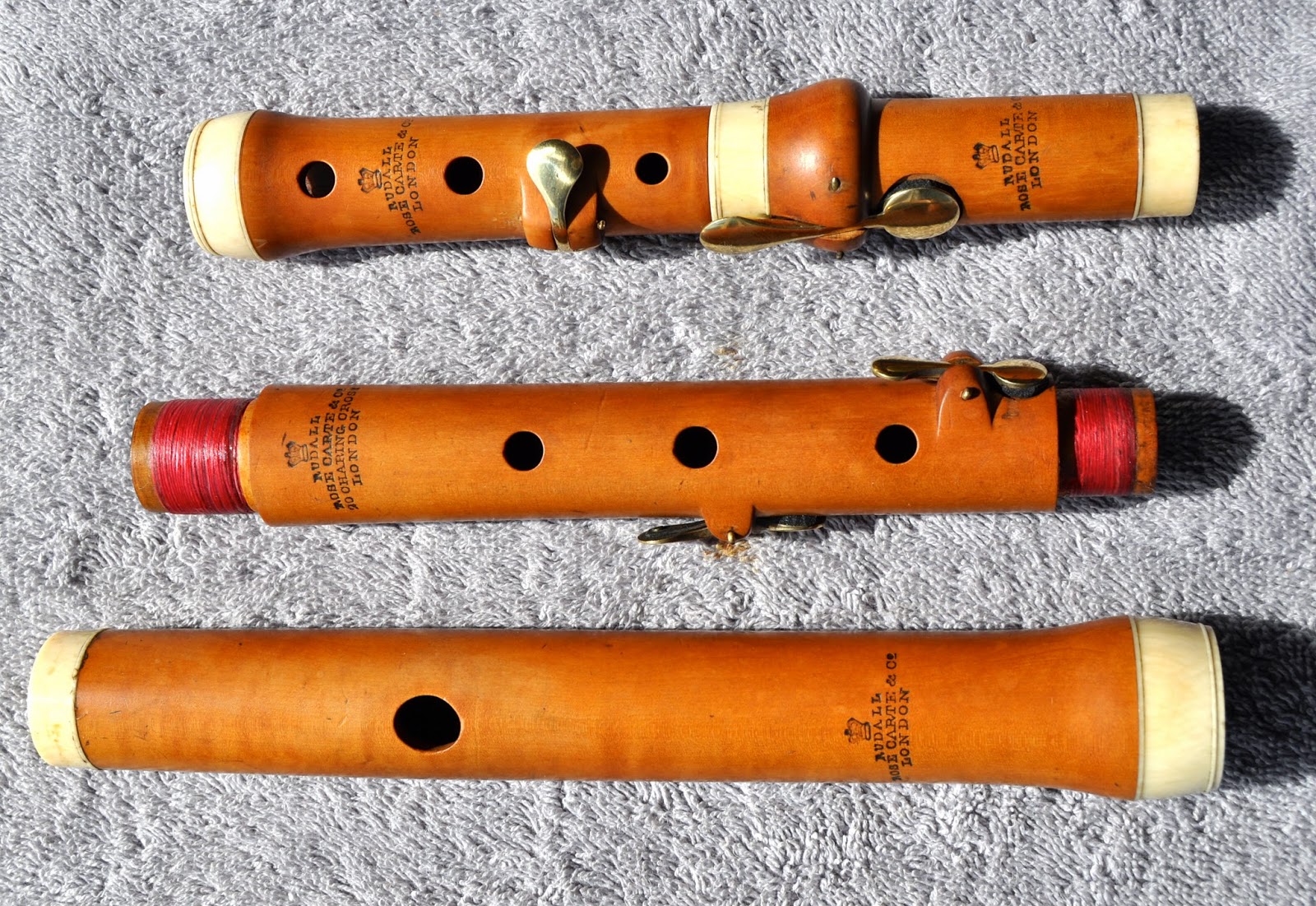
On closer examination you'll find the stamp Rudall & Rose, which interestingly is upside down on one of the joints.
I had this flute in my possession for a while, and took the trouble to measure it, revealing the bore to be typical of French manufacture, so it was not simply a Rudall in French clothing.
In cases like this though, there is also a strong possibility that R & R might have contacted one or other of the good French makers of the period, ordered a flute "sans marque" and then applied their own stamp to it once it crossed the channel.
A couple of months ago, I came across a flute in an auction, and since it seemed interesting, bid on it.
The picture provided by the auction house seemed to show a standard, four brass flap keyed, boxwood and ivory flute, which most flute aficionados would date as early 19th century, probably no later than 1810, possibly turn of the century, but the description claimed that the maker was Rudall, Rose, Carte & Co. 20 Charing Cross, which would put the date between 1854-71.
An online bid was successful, and the flute duly arrived, to be photographed, after re-padding the keys, re-threading the joints, and a very light cleaning which was all that was required. Otherwise in almost mint condition, with no cracks to the wood or ivory mounts.
Here it is:
I have to admit that I can't immediately see the reasoning behind this instrument. There is always the possibility that it's a fake, but why would someone fake a totally anachronistic instrument? Being so totally uncharacteristic for a flute of the period indicated by the stamp, we can only go on the stamp itself, and I'll have to compare it with another typical Rudall, Rose & Carte that I have to be absolutely sure, but it looks kosher to me.
One would also think that this has to be a unique instrument, perhaps ordered by an eccentric customer, but in the course of the restoration I noted typical marks, in this case a "V" on each joint and on the keys, that seem to indicate that it was part of a group of similar flutes.
Is there a possibility that the original owner wanted to experiment with early music using authentic instruments? A slim one, surely given that even today originals are fairly readily available, and must have several fold more so at the time this was made. It also seems to pre-date the early music movement by almost a half century.
A mystery, compounded by the fact that when I finally got to play a few notes on it, I discovered that it's badly, unplayably, out of tune. An unfinished instrument perhaps? Unlikely, since any corrections to the tuning would have been done long before the flute would have been finished to this stage. Or maybe not.
A few years ago, I bought, and sold on, a flute by Dan Godfrey Sons. When I got it, it was in mint condition, as typified by the crisp stamps, showing very little, if any, handling as a playing instrument.
The finger holes were tiny, much smaller than would be expected on a flute of the period, and again the tuning was abysmal. I enlarged the finger holes to typical sizes for such a flute, and produced an Eb flute which played rather well. I can't believe that this flute was sold to a player as a finished instrument, but rather had been ordered as I got it, perhaps for a keen amateur to finish to their own satisfaction?
I welcome any suggestions from readers on this flute.
Friday, 2 January 2015
Flute Making Course
I've been working on this idea for quite some time so I'm excited to make the following announcement. I'd really appreciate it if you could pass it on to anyone you think may be interested.
As you may be aware, Na Píobairí Uilleann (NPU) deliver part time and full time uilleann pipemaking training courses at their PipeCraft facility in Clonshaugh, Dublin 17. The PipeCraft training facility is a fantastic resource and Na Píobairí Uilleann in collaboration with Cruinniú na bhFliúit/The Flute Meeting, have been exploring the idea of providing a one-of flute making training module, taught by Hammy Hamilton, in 2015. The course will be aimed at flute players and people interested in flute making. The idea is that the training will be provided in a single week block or possibly over three weekends. On completion of the course participants will have produced a keyless flute in African Blackwood with silver mounts. The cost of the course, which will be limited to six participants, will be €900 (Euros) inclusive of all materials and tuition. If it is of interest to you or someone you know, please advise Cruinniú na Bhfliúit/The Flute Meeting by e-mail ( flutemeet@gmail.com) and include details of your preferred option - week long or weekends - and the month of the year that would be most suitable.
I'll keep ye posted of any developments...
Oh, and Happy New Year
As you may be aware, Na Píobairí Uilleann (NPU) deliver part time and full time uilleann pipemaking training courses at their PipeCraft facility in Clonshaugh, Dublin 17. The PipeCraft training facility is a fantastic resource and Na Píobairí Uilleann in collaboration with Cruinniú na bhFliúit/The Flute Meeting, have been exploring the idea of providing a one-of flute making training module, taught by Hammy Hamilton, in 2015. The course will be aimed at flute players and people interested in flute making. The idea is that the training will be provided in a single week block or possibly over three weekends. On completion of the course participants will have produced a keyless flute in African Blackwood with silver mounts. The cost of the course, which will be limited to six participants, will be €900 (Euros) inclusive of all materials and tuition. If it is of interest to you or someone you know, please advise Cruinniú na Bhfliúit/The Flute Meeting by e-mail ( flutemeet@gmail.com) and include details of your preferred option - week long or weekends - and the month of the year that would be most suitable.
I'll keep ye posted of any developments...
Oh, and Happy New Year
Sunday, 28 December 2014
Ebonite
Well, first of all, a Happy Xmas to all my readers, or as we'd say around here nollaig shona díbh go leir.
Finished a set of whistles the other day using a new material, well new to me anyway. In fact it's a very hard vulcanised rubber, dating from 1839, which was used for all sorts of purposes, including flutes, in its day.
Rockstro, he of "A Treatise on the Flute "fame, was a keen advocate of the material:
Ebonite embraces more good qualities than any other material ever used for the manufacture of flute tubes. This valuable and well known compound, often called vulcanite, consists of India -rubber, sulphur and lead, mixed with a black pigment and subjected to great heat. Its first employment in the construction of flutes is not of recent date, for in the great exhibition of 1851 I saw one that was made of it. This was however, but a very rude instrument and it attracted little attention. About twenty years afterwards Messrs Rudall, Rose Carte & Co. undertook the manufacture of ebonite flutes, and these instruments are now more popular in England than any others. If we compare the qualities of ebonite with the list of requirements of a flute-tube, we shall find that it leaves little to be desired.
Firstly, then in the matter of endurance it may be pronounced perfect for it is practicably indestructible.
Secondly, as it is absolutely non-absorbent of moisture no change in the dimensions of the tube ever occurs, and a metal head-ling is unnecessary.
Thirdly, an ebonite flute invariably improves by judicious use.
Fourthly, this substance possesses just the amount of rigidity necessary for the retention of the enclosed air-column in its proper shape and dimensions, while its own vibrations sympathise so readily with those of the air within, that the sound is produced with as little expenditure of the breath as on a metal flute. This latter circumstance renders ebonite flutes particularly suitable for the use of ladies, and for whom none is better adapted. The excellent and brilliant performer Miss Cora Cardigan ( Mrs. Louis Honig ), known as the "Queen of Flute-Players," always plays on an ebonite flute. The charming quality of the tone that this talented lady elicits from her instrument is too well known to need any panegyric in these pages.
Fifthly, this material is so bad a conductor of heat that ebonite flutes are far less affected than any others, in their pitch, by alteration of temperature.
Sixthly, its appearance excels that of the finest ebony, and it generally retains its original lustre with very little attention, though sometimes it loses its extreme blackness.
The practical consequences of all these theoretical perfections is that a flute made of ebonite possesses great endurance combined with capabilities for producing power, softness, volume, brilliancy, sweetness, clearness, flexibility, and general variety of tone, in a greater degree than one of any other material, a slight reservation being necessary in the case of the single quality of power, and if this is a trifle less than that of a cocus wood flute with metal head-lining, the other advantages so immeasurably outweigh the exceedingly slight inferiority in this respect, that ebonite must be pronounced the veritable beau ideal of the material for the tube of a flute.
Not sure that I agree with all of that, (especially the length of the last sentence!), and it would make one wonder if Rockstro had a commercial interest in ebonite. It is a useful material though, and the samples I was sent by Schonberger Ebonite I've been experimenting with. First attempt is the whistle heads, which look great. ( I think anyway ). Here's a couple of pics:


Finished a set of whistles the other day using a new material, well new to me anyway. In fact it's a very hard vulcanised rubber, dating from 1839, which was used for all sorts of purposes, including flutes, in its day.
Rockstro, he of "A Treatise on the Flute "fame, was a keen advocate of the material:
Ebonite embraces more good qualities than any other material ever used for the manufacture of flute tubes. This valuable and well known compound, often called vulcanite, consists of India -rubber, sulphur and lead, mixed with a black pigment and subjected to great heat. Its first employment in the construction of flutes is not of recent date, for in the great exhibition of 1851 I saw one that was made of it. This was however, but a very rude instrument and it attracted little attention. About twenty years afterwards Messrs Rudall, Rose Carte & Co. undertook the manufacture of ebonite flutes, and these instruments are now more popular in England than any others. If we compare the qualities of ebonite with the list of requirements of a flute-tube, we shall find that it leaves little to be desired.
Firstly, then in the matter of endurance it may be pronounced perfect for it is practicably indestructible.
Secondly, as it is absolutely non-absorbent of moisture no change in the dimensions of the tube ever occurs, and a metal head-ling is unnecessary.
Thirdly, an ebonite flute invariably improves by judicious use.
Fourthly, this substance possesses just the amount of rigidity necessary for the retention of the enclosed air-column in its proper shape and dimensions, while its own vibrations sympathise so readily with those of the air within, that the sound is produced with as little expenditure of the breath as on a metal flute. This latter circumstance renders ebonite flutes particularly suitable for the use of ladies, and for whom none is better adapted. The excellent and brilliant performer Miss Cora Cardigan ( Mrs. Louis Honig ), known as the "Queen of Flute-Players," always plays on an ebonite flute. The charming quality of the tone that this talented lady elicits from her instrument is too well known to need any panegyric in these pages.
Fifthly, this material is so bad a conductor of heat that ebonite flutes are far less affected than any others, in their pitch, by alteration of temperature.
Sixthly, its appearance excels that of the finest ebony, and it generally retains its original lustre with very little attention, though sometimes it loses its extreme blackness.
The practical consequences of all these theoretical perfections is that a flute made of ebonite possesses great endurance combined with capabilities for producing power, softness, volume, brilliancy, sweetness, clearness, flexibility, and general variety of tone, in a greater degree than one of any other material, a slight reservation being necessary in the case of the single quality of power, and if this is a trifle less than that of a cocus wood flute with metal head-lining, the other advantages so immeasurably outweigh the exceedingly slight inferiority in this respect, that ebonite must be pronounced the veritable beau ideal of the material for the tube of a flute.
Not sure that I agree with all of that, (especially the length of the last sentence!), and it would make one wonder if Rockstro had a commercial interest in ebonite. It is a useful material though, and the samples I was sent by Schonberger Ebonite I've been experimenting with. First attempt is the whistle heads, which look great. ( I think anyway ). Here's a couple of pics:
At this stage the plug, which you can't see in this photo, is still delrin, but I've been modifying the brass pin which keeps everything together, so that it's pushed into place and held there by friction.
This enables me to make each end slightly domed and polished, and makes a much simpler job of tuning the outside of the head to an even, cosmetic, finish.
I'm considering making a post mounted flute from the black sample I've received.
I'll keep ye posted...
Sunday, 2 November 2014
New Machines, at last!
Summer has a habit of overtaking one in various ways, and this summer was no exception. Here, in the south West I'm looking out the window at the first wet day ( in the sense of it raining continually all day) since the middle of April. It's been the finest, and driest summer for many, many years.
The up shot of all this is that I spent a lot more time in the garden and doing outside work in general than would normally be the case. We also had the problem of four large trees which were blown down on Stephen's day last year, and which brought down a large garden wall with them when they went.
The dry summer allowed us to bring in the necessary machinery to clear all this and replace the wall.
Other things, getting around to flutemaking, also conspired to hold things back, and possibly explains the absence of any post since the middle of July.
Major among these was the replacement of the two major machines in the workshop.
At some stage, early in the year, I came to the realisation that my old workhorse of an engineering lathe, the Colchester Chipmaster, was going to have to go sooner rather than later. Working with tools over a long period, it's really hard to see the gradual deterioration in accuracy and efficiency that occurs little by little day by day. It wasn't until I used my neighbour's Harrison M300, for a reason that I now can't remember, that I saw the degree of deterioration in my own machine.
Around the same time I was increasingly frustrated with the performance of the small mill/drill, and also the fact that my large mill, although wonderful in every other way, had no quill, and therefore couldn't be used for the accurate drilling that the small machine wouldn't do.
Buying second hand machinery, and I can only speak of the Irish experience, can be a bit of a dose to be honest. There's lots available, but mainly through auction and on-line selling sites sites. This usually means that you have to buy sight unseen, and very often are not able to see a machine running. The other problem, this time particular to flutemakers, or at least those working on the same scale as I am, is that most of the machinery available is too big, if not for the type of work, then for the workshop space available. By means of an inquiry to one of the on-line buying/selling sites, I came across a place in Longford which had exactly what I was looking for in terms of a large selection of second hand machines that could be seen, many in operation.
As it happened I was scheduled to go to Leitrim for the launch of the John McKenna project, so I took the opportunity to call to the village of Kenagh on my way, it not being a place on the way to anywhere really, or at least not any where that I'd normally be going. To my delight, I discovered that they were expecting to get in the two exact machines that I had been looking for. These were the Excell Pinnacle Top Aid Turret mill, and the Harrison M300 lathe.
Cutting a long story short, I managed to sell my own machines, and buy the two "new" ones and get them installed in the workshop by late August.
Here they are... the mill

and the lathe...

and that's my Harrison Union Graduate wood lathe in the background. You can't beat Harrison!
By coincidence the people I bought the machines from were the Harrison brothers whose company is Kenequip.
I couldn't recommend these guys highly enough, they were a delight to deal with, sourcing the machines, delivering them, and even helping with the installation.
I don't know myself.
The up shot of all this is that I spent a lot more time in the garden and doing outside work in general than would normally be the case. We also had the problem of four large trees which were blown down on Stephen's day last year, and which brought down a large garden wall with them when they went.
The dry summer allowed us to bring in the necessary machinery to clear all this and replace the wall.
Other things, getting around to flutemaking, also conspired to hold things back, and possibly explains the absence of any post since the middle of July.
Major among these was the replacement of the two major machines in the workshop.
At some stage, early in the year, I came to the realisation that my old workhorse of an engineering lathe, the Colchester Chipmaster, was going to have to go sooner rather than later. Working with tools over a long period, it's really hard to see the gradual deterioration in accuracy and efficiency that occurs little by little day by day. It wasn't until I used my neighbour's Harrison M300, for a reason that I now can't remember, that I saw the degree of deterioration in my own machine.
Around the same time I was increasingly frustrated with the performance of the small mill/drill, and also the fact that my large mill, although wonderful in every other way, had no quill, and therefore couldn't be used for the accurate drilling that the small machine wouldn't do.
Buying second hand machinery, and I can only speak of the Irish experience, can be a bit of a dose to be honest. There's lots available, but mainly through auction and on-line selling sites sites. This usually means that you have to buy sight unseen, and very often are not able to see a machine running. The other problem, this time particular to flutemakers, or at least those working on the same scale as I am, is that most of the machinery available is too big, if not for the type of work, then for the workshop space available. By means of an inquiry to one of the on-line buying/selling sites, I came across a place in Longford which had exactly what I was looking for in terms of a large selection of second hand machines that could be seen, many in operation.
As it happened I was scheduled to go to Leitrim for the launch of the John McKenna project, so I took the opportunity to call to the village of Kenagh on my way, it not being a place on the way to anywhere really, or at least not any where that I'd normally be going. To my delight, I discovered that they were expecting to get in the two exact machines that I had been looking for. These were the Excell Pinnacle Top Aid Turret mill, and the Harrison M300 lathe.
Cutting a long story short, I managed to sell my own machines, and buy the two "new" ones and get them installed in the workshop by late August.
Here they are... the mill
and the lathe...
and that's my Harrison Union Graduate wood lathe in the background. You can't beat Harrison!
By coincidence the people I bought the machines from were the Harrison brothers whose company is Kenequip.
I couldn't recommend these guys highly enough, they were a delight to deal with, sourcing the machines, delivering them, and even helping with the installation.
I don't know myself.
Subscribe to:
Posts (Atom)