Sunday, 13 November 2022

George Rudall and John Willis

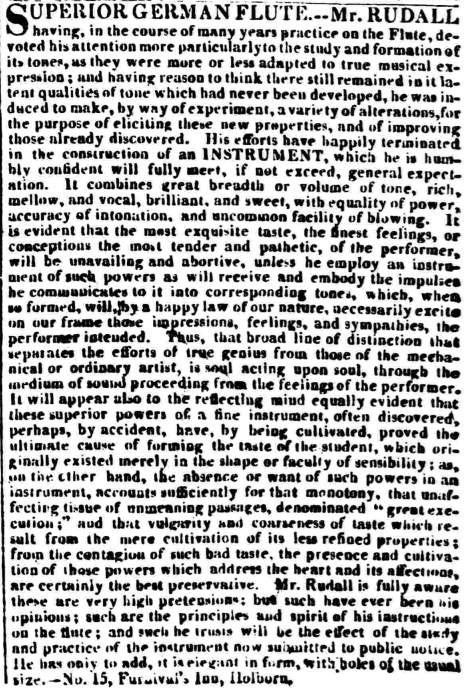
It's well known among old flute enthusiasts that the famous firm of Rudall & Rose was founded in 1821 by the flute teacher George Rudall and the flute maker John Mitchell Rose. However it's the flutes that George Rudall had made in the few preceding years by the maker John Willis, and in particular one of those flutes, that is the subject of this post.

It was a very common arrangement for well known "professors" of the flute to associate themselves with a particular maker, and would provide these flutes to their students and others, and in this case Rudall chose his collaborator well.

 John Willis came to prominence as a maker in the early 19th C,  someone who made flutes for resellers, but operated on his own account from several addresses. Here's what the NLI has to say:


  John Willis had a younger brother, Isaac who initially operated from Dublin, taking over from the Goulding d'Almaine & Potter operation there in 1816, later moving to London. I hope to reveal more about Isaac in future posts about the Dublin woodwind trade, but I'll leave it till then, since his relevance to this post is simply to acknowledge him as John's brother. It's thought that Isaac was purely a reseller, and never made on his own account.

When did John Willis make the flutes for George Rudall? 

Rockstro says that he resigned his commission in the army ( he had been a Lieutenant in the Devonshire Militia ) around 1820 and commenced as a flute teacher and supplier of instruments at that time. However there is quite a lot of evidence to contradict this, which shows that he was a flute teacher by 1816, and this might help explain why many of these flutes survive. This has been discovered recently:


This seems to suggest that he was providing flutes by 1816, and the details of the famous court case, as related by Robert Bigio, also show that he was teaching music by that date. I had always thought that a remarkable number of the Willis Fecit flutes survived given that the supposition ( stemming from Rockstro and repeated in the NLI ) that he didn't leave the army until 1820, and formed Rudall & Rose in 1821, but a period of 5 years does make more sense in terms of the number of surviving instruments. 


One aspect of this that has always struck me as odd, is that while Willis was a well established maker, making flutes of superb quality, Rudall chose to move to another supplier for his flutes and he chose someone who had little or no reputation as a maker.  John Mitchell Rose is a mysterious figure about whom really very little is known, given that he was one of the major figures in the 19th century English flute community. 

I'd advise reading Robert Bigio's account of him in his " Rudall, Rose, and Carte. The Art of the Flute in Britain".

There are several other interesting aspects of the flutes that Willis made for Rudall. Firstly, given the relatively short period that the association lasted, a surprising number of the flutes have survived. Secondly, the degree of variation between the individual flutes is remarkable. This is most noticeable in terms of the style of key work, for example in the two DCM examples, one has padded keys and pewters on the foot, and the other has pewters throughout, and an "up and over"  C#/C mechanism, very much in the style of Potter. 

I've also seen examples with square flap keys, and I've one in my own collection which appears to have been originally made for flap keys, but converted to pads. Most of these flutes are 7 keyed, missing the long F, but mine is an 8 keyed with some other rather quirky variations, e.g. the blocks are lined except the main long F block, even though the guide block is! This I'm sure is entirely original.

 The woods that Willis used were standard for the time, boxwood, and cocus, for the most part, but this particular flute is made from neither, but rather one of the woods from the Caribbean genus Platymiscium.

Having worked in flute restoration for over 40 years gives me some insight, I believe, into the woods that the old makers used. The vast majority, of course are either boxwood (Buxus sempervirens), or cocus (Brya ebene), with the occasional appearance of ebony ( Diospyros spp.), and rosewood and African blackwood (Dalbergia spp.). One confusing aspect of wood nomenclature ( see my post -A Wonderful Confusion ) are the wildly inaccurate descriptions of wood type in auction catalogues, and very often even museum catalogues. In fact it's only with long experience, and some botanical training that one begins to be able to be confidant about identifying these woods and to realise that there is another timber which was quite widely used.

It's only relatively recently that I began to realise that this timber was turning up in my restorations more and more often, and in very high quality instruments as well, and from diverse sources including London, Vienna, and New York.

So how to recognise it? One of the really characteristic "tells" is the presence of chatoyance, which in itself requires an explanation. Look at this video first...( and apologies for redirecting to YouTube, for some reason Blogger would not allow me to upload the video directly)


This in fact, is the barrel of a Hudson Pratten. The optical illusion that there appears to be "depth" to the surface, almost as if there were a very heavy coat of clear varnish and we're looking through that to a grain pattern that is actually below the surface is the essence of chatoyance. The term in English derives from the French Oeil de Chat - cat's eye, and this is obviously related to the term tiger's eye effect that you'll see used to describe the same phenomenon. If you're still unclear about this, think of the beautiful rippled figure that you'll see on the maple back of a quality violin, and how it actually appears to be below the surface.
The second "tell" which can be seen with the naked eye is the presence of very large pores in the end grain, but given that end grain on flutes is very often coated with grease and various finishes, this is not always obvious. Here, for comparison, is the end grain of cocus,

and that of Platymiscium


I think you'll agree that they look quite distinct. These images are x50 magnification


However, this is not the place to go into any more detail about the type of wood. I just wanted to establish that we're not dealing with what most people might assume is an instrument made from highly figured cocus.
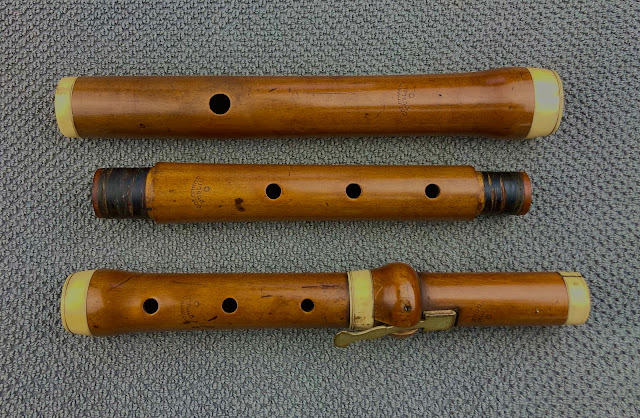
So let's get to the flute itself...


and the stamps...
                                                                             
 Here on the barrel

This image also shows the extremely high finish which characterised the flute, and which in fact allowed the chatoyance of the grain to come to the fore. It's also noticeable that the stamp was applied after the finish was complete. I have to  comment here re the crooked stamp, that it remarkable how often one sees this on really high quality flutes...and it also reveals that each line of the stamp was a separate tool.
And here's the foot, with the "Willis Fecit"


The flute is eight keyed with pewter plugs on all the foot joint keys, but the other five keys are somewhat unusual in that they bear a close resemblance to the type of keys one sees on many Monzani flutes from the same period. This is essentially a development of the flat "flap" type key, but where the key shaft and the flap are two distinct elements. These photos show the basic idea.


...and this, which is actually the newly made long F key, shows the details of how it's put together,


Here, for comparison, is the Monzani set up.


Things to note here are:
1/ The screw which holds it all together is riveted through the key shank. You can see evidence of this in the middle of the crown stamp.
2/ Note the milled edge of the disc, a typical Monzani feature... and from left to right: the washer holding the leather pad in place, the leather pad, the silver disc, N.B. little washer between the disc and the key shank, and finally the key shank.
3/ The two little holes in the washer to allow is easy removal and replacement.


Let's look at the key work in general. It's fairly standard but there are some interesting features. At first glance, it appeared that this had originally been a seven keyed flute and that the long F was a later edition, mounted on a silver saddle.


The fact that the key "cup" arrangement is different to the other keys as illustrated might be another indicator that the key is an addition, as in this case its integral with the key shaft, but seems to have been added to original shaft.
However, those familiar with how blocks were reinforced on many 19th c. flutes will notice the two silver spots on either side of the long F.  These are the ends of a threaded pin which was added to strengthen the block, and are incontrovertible evidence that there was a long F on this flute originally. In fact, I think that the silver "saddle" which appeared to be a means of adding the extra key, is in fact the silver block liner of the original key. These pins are more often steel, but in this case are silver.

More of this later, but there's one other aspect of the keys that is unusual, the separation of the long C guide block, and the Bb block which are normally conflated in the same block.


I've seen this arrangement on several flutes, but it is unusual. I think I'm begining to see a pattern, but I'm not going to reveal my hand...yet.


Overall, the flute was in really very good overall condition. It was playing very well when it arrived to me, and the only potential issue was the very fine crack in the head.
However the owner asked me to restore the flute to its original state, including restoring the long F key and its block.

The first job was to deal with the crack in the head. This is what it looked like on arrival...


The highly reflective nature nature of the finish, made this flute very difficult to photograph, but you can see that the crack appears to be reasonably recent,  and therefore clean, without any material, dirt or grease, in the crack. This makes the repair so much easier.
As usual, far more time is spent in the cosmetics rather than the actual repair, but time well spent, I think. Here's the result.


Replacing the long F block first of all required sourcing some Platymiscium, which I did from www.rarewoodsusa.com. who I can highly recommend. There are many species in the Platymiscium genus, and it's impossible to separate them at a timber level, but one of the most suitable for our purpose is Platymiscium yucatanum, so that's possibly the timber I used for this.

The first job was to remove the block liners, milling out sections which matched the length of the block liners, which of course allowed my to replicate the original height of the block.


Here you can see the block support pin, which I carefully milled around as I wanted to re-install it.
With block replacement work of this type, the basic physical work can often be only a small part of the process. The cosmetic work is what takes the time. 
In this case, several unusual factors complicated this. Firstly the type of wood, which took some time to source. Secondly the very high gloss finish was not easy to reproduce. Also important here is the wide variation in the grain pattern of Platymiscium, which can vary from tight non "flamed" grain to very open grain with large light and dark patches interacting. Normally, I spend quite a bit of time matching the piece of timber I'm going to inlay with the grain where it's going to be inlaid, but this process can be a lot more difficult with Platymiscium. Here are the results...


The lighter coloured timber tended to be at the tops of the blocks, so I tried to  match that with the new long F blocks.


Here's a view from above, and it leaves me thinking that the liner of the support block is not original, as the gauge of silver used is considerably thicker.
This also shows the finished new long F key, and I'll just re-show the rather complex elements which go to make up what is essentially a flat flap key.


From left to right these are:
1/ The key shaft itself.
2/ The main section of the key which carries the leather pad.
3/ The washer which holds the leather in place, with the two little holes which allow it to be turned securely into place.
4/ The threaded pin which holds it all together.

Here's the washer on one of the old keys, with an original Monzani screwdriver. You can see that they don't quite match, but you get the idea.


Working in such small scale is difficult at the best of times, but the major challenge here was threading the little pin. It turned out to be as near as dammit to a 1.6mm thread, which amazingly is one of the very small metric taps standardly available.
The problem here was that silver of such small diameter has little tensile strength, and kept breaking off when tapping. Next time, I'll try to work harden it, or try a bit of heat treatment.

Working with such gorgeous instruments as this, and in a way to be looking over the shoulders of the original makers, as I do the work, conscious of the way they went about theirs, is one of the great privileges of this job. 


Monday, 25 July 2022

Irish Flutes Part 2

 In my last post on this topic, I suggested that there were potentially three groups of maker/dealers involved in flutes that were ostensibly of Dublin manufacture. 

One of the many problems facing research in this area is the rarity of such instruments, which makes comparisons quite difficult.

The Dublin Music Trade resource names 18 woodwind makers naming flutes among their wares, who operated in Dublin in from the mid 18th - the mid 19th centuries, and of course there were a few more in Cork and other places outside Dublin. Of these, less than 25 instruments are currently known from only 12 makers, of which 14 are flutes. (Excluding Butler, who being a later maker having a London branch has very many known instruments) Alphabetically they are:

Brown, Butler, Colqhoun, Connor, Cowlan, Dollard, Ellard, Heron, Hussey, Moroney, Neale, Perry, Reilly, Robinson & Bussel, Stokes, Thornton, Voyer, Willis.

To this list I've been able to add two names. Firstly Finnegin (sic) whose single key boxwood flute is stamped CORK, and who may be the same person as the uilleann pipe maker Finnegan recorded from early 19th century Cork. Secondly, a double flageolet stamped C. Toomey Dublin, surfaced very recently at an auction in Switzerland. This Toomey is more normally thought of as an American maker based in Georgetown D.C., and even though it's unlikely that this instrument, in common with many of the ones under consideration here, was actually made in Dublin, it is another Dublin stamped instrument which inspires me to look further into C. Toomey's potential Irish background.

The information I can garner about these makers further confirms the inter-relationships (dynamic) between the three groups that I propose were involved in the Dublin flute making scene in late 18th and early 19th century Dublin; 

- Makers of uilleann pipes who also offered flutes.

- Makers of flutes and other woodwinds for the classical trade.

- London makers who made flutes then stamped with the marks of either or both of the previous two groups.


In the last while I've managed to get hold of two very nice examples of flutes made in...or at least stamped...Dublin, and another, which although from a Liverpool address, is from a maker whose Irish origins are undisputed, and who had previously worked from a Dublin address. 

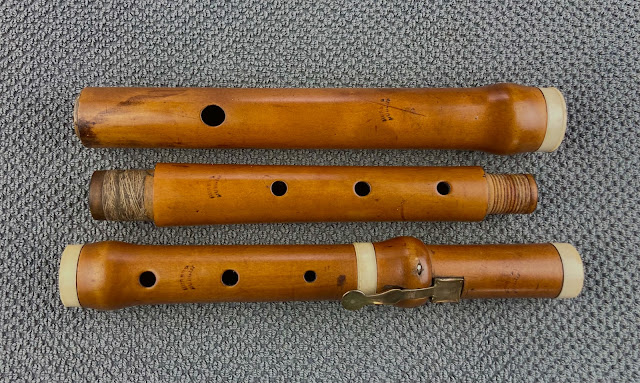
The first two are one keyed boxwood and ivory instruments typical of the turn of the 18th/19th centuries

One of these is stamped Colquhoun Dublin, a name listed in the Dublin Music Trade website under several entries. In fact, there were two Colquhouns, Henry and George, who worked in association with several others. ( indeed there was a third, William, who is listed as a musical instrument maker in Cork, but of whom nothing else is known) 


This must be the first and only time that I acquired a flute whose maker gets mentioned in a poem the context of which is detailed by Carolan ( see refs below)

Here's the extract from "An Heroic Epistle, from Kitty-Cut-a-Dash to Oroonoko"

Love's mystic pleasures o'er, a minstrel near,

Obsequious waited, to delight the ear

In these degenerate times, a piper named,

The first of Tibecens, tho' little fam'd

His pipes of sable ebony were made,

By Colq'houn, skilful in the Tibian trade;

Rings of contrasting ivory surround

The drones, the tips with burnished brass are bound:

Such tones he from his matchless chanter drew,

When o'er the holes instinctive fingers flew...

Nor was his skill to sleepy airs confin'd

But lively Notes reveal'd a lively mind,

The festive dances, Gods! How he would roar 'em!

BLACK JOKE, BOW-WOW, or PUSH ABOUT THE JORUM


George was active from 1771, but is only listed as a musical instrument maker from 1793. Henry...the two are probably related, but no evidence is offered...is active from 1765 in partnership with a John Voyer, and for two years from 1766 with John Gahagan. Unfortunately we know very little about these early Irish makers, but some of the detail recorded is intriguing. Talking about the Voyer/Colquhoun partnership in the same article, Carolan refers to a letter which appeared in Faulkner's Dublin Journal

"A letter of September 1765 records a 'Calquhoun' (sic) as having recently set up a music shop in Dublin with John Voyer, and accuses Voyer of passing off counterfeit German flutes there, supposedly made by Charles Schuchart of London."

Which must be the first time that Schuchart was ever accused of making counterfeit flutes!

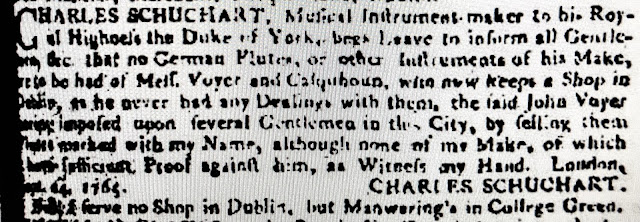
I was intrigued to follow up on that reference, and eventually now that the Covid situation allows visiting the National Library, I managed to get there a couple of weeks ago...and so here is the original...


This appears to be, not a letter, but something in a similar form to other tradesmen's notices, letting people know where certain items are to be had, or in this case, not to be had. The text is quite hard to read, so this is what it says:

Charles Schuchart, Musical Instrument maker to his Royal Highness the Duke of York, begs leave to inform all Gentlemen &c that no German Flutes, or other instruments of his make are to be had of Mesr. Voyer and Calquhoun, who now keeps a shop in Dublin,  as he never had any dealings with them, the said John Voyer having? imposed upon several Gentlemen in this City, by selling them flutes marked with my Name, although none of my Make of which I have sufficient proof against him, as witnesss my hand. London Sept. 14 1765.
We serve no shop in Dublin, but Manwerings in College Green.

This snippet is interesting in that it reveals something of the relationship between, makers and dealers, and also of the connections between the London and Dublin markets and musical scenes. It's important to understand some of the political background of the period, in particular the 1801 Act of Union, which dramatically changed the political and commercial relationship between Ireland and England. This post is not the place to do it, but perhaps at some future date a sketch of the basics would be useful.

Following up on references both in the NLI and the DMT sources led to a flute by Colquhoun in Berlin, which I was amazed to discover is a flute in F,  low F, which in the rather bizarre official naming system means that the low note, the six-finger note ( this is a one keyed flute) is G. The Berlin Musical Instrument Museum lists this as being by George Colquhoun, and the stamp is identical to that on my Colquhoun. The flute is made of very finely flamed box, with ivory mounts.

I note that the paragraphs above were written in January 2021, and it was at this stage that the Covid crisis was really starting to bite, and it took a long time to make contact with Berlin, and to get access to the images that they had. They asked me not to use the images in a publication which of course I'll comply with.

The second flute came to me in a way which illustrates the wonderfully generous nature of the flute community.

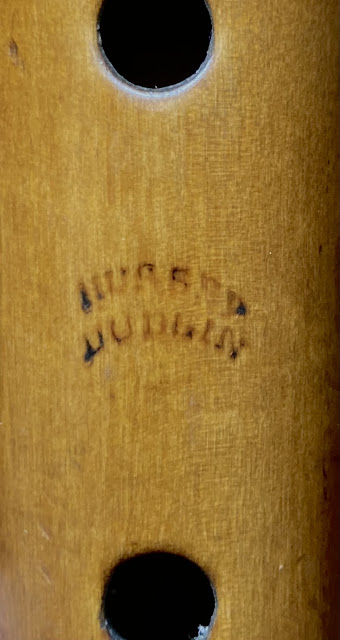
I was poking about on the internet, and came across the website of the Breton flute maker Solen Lesoueff, whom I had known about, as my friend and fellow fluter Aoife Granville has a fine example of her work.  There I noted that she had documented a series of old flutes that she had acquired from various sources, and scrolling through that, I was amazed to discover that among them was a one keyed boxwood and ivory flute stamped Hussey, Dublin.

More on the off chance than anything else I wrote to her explaining my interest in, and the research I was undertaking about the Irish made/stamped flutes. I offered to buy the flute if she was willing to sell, or swop for something in my collection that would be of interest to her.

To my great surprise and delight she offered to give me the flute, saying that it's proper home was in Ireland, and so it came into my hands.


The third instrument which increases our knowledge of "Irish" flutes, is an instrument in the Hunterian Museum in Glasgow, which I had the opportunity to visit and study some months ago.

This is an eight keyed flute in ivory and silver, which is stamped J. Reilly Dublin. I believe there is another example of this maker's work, also in ivory in the NMI. but numerous inquiries have failed to get any response from them on this front. Here's the Glasgow instrument.


This flute has several very interesting features, and I can't wait to compare with the Dublin Reilly.


One of the advantages of spending so long in putting together these blog posts is that often some other relevant piece of the puzzle turns up in the interim...and so it happened in this case, and it turns out to be one of the most fascinating pieces so far. This one came to me via Stephen Chambers who had thrown it in as part of another deal, and then couldn't find it. It eventually turned up some months later, having fallen behind a cabinet.

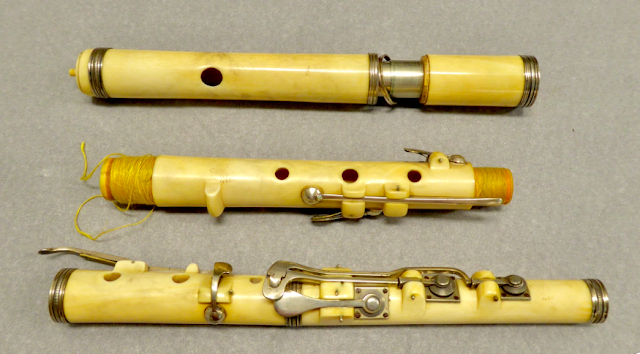
It's a 7 keyed flute ( no long F ) cocus wood and silver, and although in a bad state it still shows some very interesting features. 

The flute is stamped...

JUNr

COWLAN

2 WHITE CHAPEL

LIVERPOOL

IMPROVED PATENT

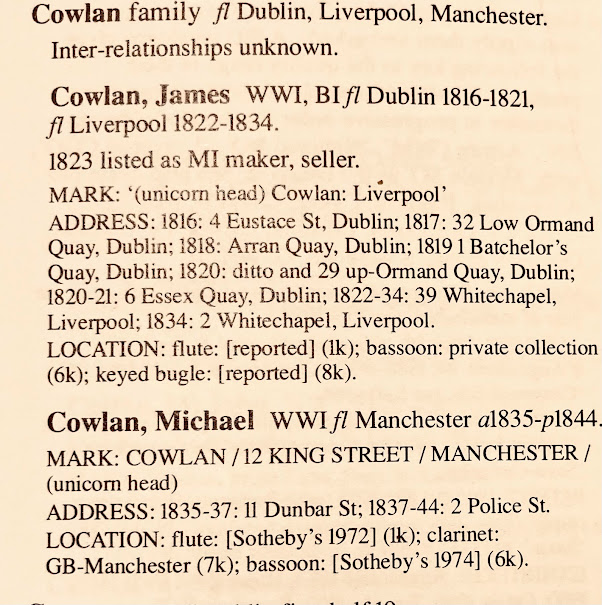
This in itself is new information in that this Jun(ior) Cowlan is presumably the next generation to the Cowlans listed in the NLI


To which of the three groups might these flutes belong? Initially, it seems that the Hussey must surely belong to the group of pipemakers who also offered flutes, while the Colquhoun, while it might potentially belong to the same group, I'm inclined to think, because of the quality of the instrument, that it might very possibly have been made for the classical market. The Reilly is very possibly then, the third group of London made instruments, stamped Dublin. But what of the Cowlan? This I find to be the most intriguing of the instruments and since my last attempt to finish this post I've become aware of quite a lot more information about the Cowlans, and also another example of his work, so I'm thinking that perhaps they deserve a post of their own.
Till the next time....

Refs:
Cutting a Dash: Uilleann Pipes in the 1760s and 1770s. Nicholas Carolan. An Piobaire, Vol 4, no. 35



Friday, 22 October 2021

The Cornelius Cabinet of Curiosity #4


One of the more delightful aspects of being a restorer, collector, and scholar of old flutes is the often peculiar way that items come to one's attention, and hopefully possession.

Every collector at some time comes across fragments which, fascinating as they might be, would be even more so if we could only see the complete instrument.

Crowley's music shop on MacCurtain St. was a Cork city institution for many, many years until it closed in 2013. From a traditional musician's, and indeed woodwind enthusiasts point of view, the story is enriched by the knowledge that the father of the owner was the renowned uilleann pipe maker Tadgh Crowley (1899-1952)

I got to know Mick Crowley in the early 1980s, initially I think, in connection with buying some African blackwood, and other timber that had survived from the old pipe making workshop, which had closed in 1966. Many of the pieces weren't suitable for flute making, but we struck up a relationship which lasted until his untimely death in 2010. Mick was a legend in Cork music circles, and you can read more about his shop and its famous customers here.

At sometime in the 80s, Mick showed me an old flute, which presumably had also come from the pipes workshop, and which would probably have ended up in the hands of a traditional player, were it not for a combination of it's unsuitability for trad music, and a scarcity of flute players in the Cork city of the time.

At that stage I was really only beginning my journey in the flute world, and all I could tell about the instrument was that it was a "frankenflute" made up of bits of different instruments. The body and the head, were that of Rudall & Rose #12...and before you all have heart attacks I have to tell you that it was an 1832 Boehm system, but of course a very early one of those as well.

The foot however is what I'm taking out of the Cabinet to show you today.

This is the front view, but you need to see it from the side to begin to appreciate what's going on here.


And what the dismantled keys look like.


It's with this side view that you begin to really see how odd this mechanism really is.

For the moment lets set the Eb key to one side, which leaves us with something which is basically mechanically similar to all 19th century pre-Boehm simple system foot joints. Two touches for the right little finger operate interacting keys, which close open standing keys for C# and C. The interaction of the keys ensures that when the player wants to play C, then the C# remains closed. In order to facilitate this essential action the touch of the C key must somehow "get around" or bypass that of the C#. This can be achieved in several ways, usually by bending the C key around or over the C#, as in these examples - on the right, a Potter from the 1790s with the 'up and over' system, and on the left Rudall & Rose #1376, with the by then standard "around the side" method 


In the foot under consideration though, the C# and C touches run parallel until they engage with the open standing pewters, and this leads to some very interesting, if bizarre, design features. The parallel nature of the touches essentially means that the C# and C holes cannot be in line, as they normally are. The obvious solution to this would seem to be to move the holes slightly to the side...one one way, and one the other, but this is not possible. Why? Because the bore of the foot is small and the C and C# holes are large, in fact just about the same as the diameter of the bore, so that moving the holes in the same plane ( at right angles to the radius of the bore) would mean that the holes wouldn't meet the bore without a little step to one side or the other. That's flute maker's talk, but here's a diagram that will hopefully make all of that clear. 
At A, you can see the walls of a hole that's almost the same diameter as the bore in the solid line, and then how a hole of the same diameter meets the bore, when the hole is shifted in a radial manner. ( the dotted lines )
At B, you can see how it's impossible to move the hole laterally and still line up with the bore.


The solution in this case was to move the holes, not in a flat plane, but around the circumference of the bore, ( as at A ) meaning that they now meet the bore without distortion. The following images attempt to show this.

Keys removed

Pewters in place


Fully assembled

This "twisting" of the mechanism is achieved by two means. 
Firstly the linkage between the touches and the pewters, being simply of the "peg in hole" type allows the plane of action between the two to be as variable as required.
Secondly, and much more complexly, the circumferential movement of the holes requires that the axles of the pewters are tilted away from a central line, one in each direction, and this is achieved by having a tall and a short pillar holding each axle. I hope the following image illustrates this.


The condition of the foot as it came to me was not mechanically good. The key touches were somewhat bent, but the major issue was that the axle rods were corroded in place. I eventually managed to remove the keys but at the cost of destroying the axles, so the assembly you see in these photos was achieved with push rods that I drew down from silver wire. As a result, the mechanism doesn't really work as I write this, but I've no reason to believe, that in it's original state it wouldn't have worked as well as any standard simple system foot joint...and this is as good a juncture as any to point out that the key work on this foot gives absolutely no mechanical advantage over the normal simple system "in line" C# and C keys.

Time now to look at the Eb key which fairly obviously seems to have a separate origin, and prompts me to reveal, that though the body discussed above was clearly stamped Rudall and Rose, the foot was clearly stamped as this image shows,

T. Prowse
Hannway St.
London


A close up of the key itself reveals several interesting features.


Remember that this foot was attached to a Rudall & Rose 1832 Boehm system, and here's the Eb key from one of those ( #18 in this case, which must have been made within weeks of #12 )


Note that the upper pillar of the Eb is in both cases an integral part of the ring, and that both our foot and that of the R & R 1832  are silver lined. ( R & R 1832 to the right)


I've spent many years now looking at this foot joint, and the more I look the more mysterious and inexplicable it becomes.

Does the stamp give up any clues?
Prowse worked in London from 1816-1868, so this is certainly contemporaneous with the body.  So could it possibly be a repurposed Prowse footjoint? That initially seemed a likely explanation, but had to be rejected due to what was pointed out above about the circumferential position of the C# and C holes. Secondly, the Eb is on the wrong side of the flute for a standard simple system foot.

It seems obvious though that the Eb key has been repurposed. Looking at the photo above you can see how the lower end of the Eb axle doesn't have its own post, but uses the tall post of the C# pewter, where a hole has simply been drilled to take the end of the Eb axle.
So the foot is clearly not part of the original flute, or at least not all of it is. The element that might be part of the original flute, is the Eb key, or at least part of it, as the touch appears to have been modified. 
There's also the possibility, given the stamp, that the Eb key could be from an 1832 Boehm system made by Prowse himself, which strongly resemble the R & R instruments, and in fact from what I can make out from the photo of a Prowse 1832 Boehm system in Robert Bigio's  "Rudall, Rose  & Carte-The Art of the Flute in Britain" (see Fig. 94, p. 91) this key may in fact resemble that of a Prowse 1832 Boehm system rather more than the R & R key pictured above.

Apart from the stamp, and the Eb key, there are certain other features which strongly implicate Prowse as the maker of this foot. Although the key work is very unusual, certain aspects of it replicate exactly Prowse's work as seen on other examples of his instruments...particularly the touches of the C and C# keys.

Here they are on the mystery foot


 and with the linkage separated...


Here's the same thing on a Prowse Nicholson
Improved #3929
                                                  

And then those same keys  dismantled

Compare how the interlinking of the C and C# touches compares on the two flutes, and I think you'll have to agree that they were made by the same hand. The way in which the C# touch (to the left) is shaped to fit under the C is absolutely characteristic of all the simple system flutes that I've seen by Thomas Prowse. 
The Nicholson Prowse is to the left, and our foot joint to the right.


There is no evidence that the touches were soldered onto some already existing key work, so the only conclusion that I can realistically come to, is that this foot was made in the Prowse workshop, presumably to replace the original foot of Rudall & Rose #12.
 But why would the owner of the flute choose to replace the original foot with something so unusual? Why not get R & R to simply make a new foot? The presence of what might be potentially the Eb key from a Prowse 1832 Boehm system, and the other elements of the keywork which strongly suggest the foot was made in the Prowse workshop still don't explain the extreme eccentricity of the construction.
It could be postulated that for some reason that the owner asked the Prowse shop to make a new foot, but then why repurpose an old key (the Eb), which I believe was not part of the original flute. And who designed the apparently unique system of operating the pewters, which as I've pointed out is of absolutely no mechanical advantage over the standard system.

I think the only conclusion to come to is that this was the flute of a wealthy amateur who had some sort of connection with the Prowse workshop.
How it ended up in Cork, in the workshop of a great uilleann pipe maker is a story that remains to be told.


Sunday, 1 August 2021

The Cornelius Cabinet of Curiosity #3

 Rudall & Rose, who although in terms of 8 keyed flutes at any rate, produced a very recognisable style of flute over a period of almost 100 years, were also notable for undertaking to produce a very wide range of different flutes...if asked to do so.

Cabinet #2 was such an example, although perhaps, given that this was a very early example, it could be claimed that they hadn't developed their house style to the extent that they later achieved.

This flute though, is much later, and can be accurately dated, and although it has strong elements of the house style has also many idiosyncratic features.

This is Rudall & Rose #5631, address as stamped is:

                                            38 SOUTHHAMPTON ST.

                                                        STRAND

                                                        LONDON

Which rather conveniently dates it to 1847-50


Pictured like this the flute appears perfectly normal, but a view of the whole instrument shows the "curiosity" value.


As you can clearly see, this is a five keyed flute, with keys for Bb, G#, short F nat, Eb, and low C#, made at least 50 years after 8 keys had become the standard set up.
In fact this particular arrangement of keys occurs in some of the very earliest flutes with multiple keys from the 1760s and 70s, such as those by Potter Senior for example.
Why was this flute made, and for whom? Unfortunately, we'll never know.

What is remarkable is the condition of the flute. It was bought at auction in 2007, and received only the most superficial of restoration, pads, rethreaded joints, and and a light polish to the keys. This indicates to me that the flute has had very, very little use. It came in the original case, which was also almost pristine.
I've always believed that a good indicator that a flute has seen little use is the condition of the stamp on the upper middle joint, since it's just where one holds the flute to assemble and dissemble it. In this case it's absolutely crisp.
The condition of the flute leads me to believe that a very short time after it was acquired it was basically abandoned as a playing instrument, but had obviously been carefully stored.
Surprising though that it should have been "abandoned" in any sense as it's one of the finest R & Rs that I've ever played.

Here's the embouchure...

And a couple of details of the key work, showing the short F tilted for easy access by R3


and the lonely C# key...


However I've saved the most unusual thing to last.

I was so impressed by this flute and its playing capacity that I took measurements, and discovered what is the really curious thing about this instrument, which, in fairness will only mean something to another flute maker or restorer.

The bore of the cone bore flute, to give a rather simplistic account, is not generally a straight unvarying taper, certainly not in a flute of this period. Again to simplify matters, each joint follows a very broad pattern of starting at the wide end with a steep taper, followed by a less steep one.
Contrary to many people's idea, this variation in taper was not produced by having a profiled reamer which incorporated the two tapers in the one tool, but rather by using two reamers, the one with the less steep taper first, and then opening out the upper end with the reamer with the steeper taper. 
In this case however, although the lower joints follow the "standard" pattern, the upper middle most remarkably demonstrates the reverse, in that the steeper taper is in the lower end of the joint, as in B here...


Having thought about this for some considerable time, I even went back and recently re-measured the upper middle to make sure that I hadn't imagined it...but no - it is what it is.
How was such a bore made? And probably more importantly, why was such a bore made?
It must be understood that this was not simply a matter of using the reamers "the wrong way round", and although there may be ways of doing this using two separate reamers, it seems to me that in this case probably a profiled reamer was used.
Apart from this anomaly, the bore is a standard one for a R & R of the period.
All in all, definitely a good candidate for the Cabinet of Curiosity.


Sunday, 28 February 2021

A Wonderful Confusion

The question of whether the material that a woodwind instrument is made from affects the sound and what might be called the playability of the instrument is a topic that appears with great regularity on fora as different as on-line discussions and the scientific press. This often takes the form of comparisons of the characteristics of instruments made from wood, metal, or plastic, but does indeed often also discuss the merits or otherwise of different wood types as well.

Those within the Irish wooden flute community will be familiar with arguments about boxwood versus blackwood versus cocus, and I think every musician's experience is that the material does indeed make a difference, but how to characterise that difference, and how to demonstrate scientifically that it actually exists is another matter.

As a flute maker, timber is by necessity one of my major concerns, and in fact any woodwind maker will spend a lot of their time sourcing, buying, seasoning and preparing it. This post however is not so much about the nature of wood as a material, but rather about how much, or in many cases how little, we as makers actually know about it. So to begin, a brief history lesson.

Broadly speaking, the first woodwind instruments were made from natural tubes, and some very sophisticated instruments, mainly in the East, still use natural tubes today. In the West however, tubes made by boring out solid wood began, even by the early medieval period to become standard. Right from the beginning there seems to have been a realisation that harder, denser wood gave a better sound, and woods of choice would have been fruit woods such as apple and pear, but also boxwood. Boxwood (Buxus sempervirens), is found in England,  but the makers preferred wood from further east. Rendall says:

The better qualities come from Italy and Spain, the best, the mottled Abassian boxwood, from the shores of the Black Sea. The English variety, while tougher, has a fatal propensity to warping.

In terms of the flute, it is around the time of the development of the baroque flute, towards the end of the 17th C., that we begin to see what are generally called exotic woods appear. It is no coincidence that this corresponds with the great expansion of European trade to the Americas and the Far East around this time, and I'm inclined to believe that these woods were not initially imported with woodwind making in mind, but rather for the furniture, treen, and even dyeing trades. In fact it is thought that much cocus and grenadilla was obtained as a side product of sugar importation. Rendall, speaking of wood used in the clarinet trade, says:

Cocuswood ( Brya ebenus ) was long a popular material with English players and makers. It has every good property. It is very hard, resonant, easily worked, durable, and its high resinous content makes it very resistant to moisture and atmospheric changes. The best qualities come from Jamaica - it was long exported as dunnage in sugar ships- but is now very scarce. ( Dunnage? loose wood, matting, or similar material used to keep a cargo in position in a ship's hold)

It is these exotic woods, and the high level of confusion about their source and even identity that I want to discuss in this post.

When starting to research this topic, perhaps not surprisingly since I'm dealing largely with 19th C. flutes, I began with a source from that period.


This book is a classic, and has often been reprinted ( the image above is from the 2nd ed.) and for anyone involved in craftmanship of any kind, particularly that concerned with the restoration of any type of object made in the 19th C. I highly recommend it.
Note that this first volume deals with the basic materials used in manufacture, and interestingly deals specifically with the the very woods under discussion.
On a first reading, I was forcibly struck by two things. Firstly there was no certainty about what the woods actually were, and secondly and even more surprisingly, no certainty as to where they came from. Remember the date of publication -1843 (2nd ed. above was 1846) places it at the zenith of wooden flute simple system manufacture. But read for yourselves... here's an entry of interest to us.


BLACK BOTANY BAY WOOD called also African Black-wood, is perhaps the hardest and also the most wasteful of all the woods; the billets are very knotty and crooked, and covered with a thick rind of the colour and hardness of boxwood; the section of the heartwood is very irregular, and mostly either indented from without, or hollow and unsound from within; many of the pieces have the irregular scrawling growth that is observed in the wood of the vine. The largest stem of Black Botany-Bay wood I have ever seen, measured transversely eleven inches the longest and seven and a half the shortest way, but it would only produce a circular block of five inches, and this is fully two or three times the ordinary size. The wood when fresh cut is of a bluish-black with dark grey streaks but soon changes to an intense jet black. Of the few sound pieces that are obtained, the largest maybe perhaps five inches, but the majority less than two inches diameter. It is most admirably suited to eccentric turning, as the wood is particularly hard, close, free from pores, but not destructive to the tools, from which when they are in proper condition it receives a brilliant polish. It is also considered to be particularly free from any matter that will cause rust, on which account is greatly esteemed for the handles of surgeons instruments. The exact locality of this wood has long been a matter of great uncertainty. It has been considered to be a species of African ebony but its character is quite different and peculiar; I have how ever recently heard from two independent sources that it comes from the Mauritius, or Isle of France. Col. Lloyd says the wood is there called Cocobolo Prieto; that is not the growth of Mauritius, but of Madagascar to the interior of which island Europeans are not admitted and that it is brought in the same vessels that bring over the bullocks for the supply of food. The stonemasons of the country used splinters of it as a pencil for marking the lines on their work. It makes a dark blue streak not readily washed off by rain.

I have only met with one specimen of this wood in the numerous collections I have searched, namely in Mr Fincham's: he assures me that his specimen grew in Botany Bay and was brought direct from thence with several others, by Captain Woodruff, R.N.  As I have recently purchased a large quantity imported from the Mauritius, it is probable that this wood, in common with many others, may have several localities. It would be very desirable for the amateur turner that the wood should be selected on the spot, and the better pieces alone sent, as a large proportion is scarcely worth the expensive shipment but the fine pieces exceed all other wood for eccentric turned works.


One thing about the above account, which makes me as a maker with forty years experience of African blackwood, very suspicious, is the description of the colour of the fresh wood. I've never seen fresh blackwood that was even remotely of that description. 

Admittedly, in 1843, what we now call African Blackwood was not in great demand by the woodwind industry, but cocus was at that stage the major wood in use for flute making...or was it. Holtzapffel ( whose name, curiously, translates as Applewood ) again...

COCOA WOOD It is really singular that the exact localities and the botanical name of the Cocoa wood that is so much used, should be uncertain: it appears to come from a country producing sugar, being often imported as dunnage, or the stowage upon which the sugar hogsheads are packed: it is also known as Brown Ebony, but the Amerimnum ebenus of Jamaica seems dissimilar.

(Here the account goes on to describe specimens, with their local but not Linnean names, from various wood collections which are similar to Cocus.)

He finishes with

The cocus wood of commerce is not easy to trace to any of the trees of the West Indies, the cocoa plum is Chryso balanus icaco which forms only a shrub; Cocoloba uvifera, or mangrove grape tree, grows large and yields a beautiful wood for cabinet work, but which is light and of a white color. In appearance and description it comes near to the Greenheart or Laurus chloroxylon which is also called Cogwood.

So far we have two types of cocus, apparently separated by their geographical origin, and one of them is also known as grenadille...but then...

GRENADILLO, Granillo, or Grenada Cocus, from the West Indies, is apparently a lighter description of the common cocoa or cocus-wood, but changes ultimately to as dark a colour, although more slowly. It is frequently imported without the sap. The tree yielding this has not been ascertained, the Bois de Grenadille of the French, is also called red ebony by their cabinet makers.

Is this a third wood or not? Interesting as well is the statement that basically it was not known what tree yielded this timber, and in fact no IDs are given to the other Cocus varieties or to the African Blackwood/Botany Bay wood. Yet despite Holtzapffel's assertion that the botanical name of cocus was uncertain, the species of trees that we now know as cocus and the other woods under discussion here had been known to science for some time. Cocus we now know as Brya ebenus, but that specific name was allocated in 1825, and that of African Blackwood, Dalbergia melanoxylon seven years later in 1832. Remember that Holtzappfel was published in 1843. Rockstro, much later in 1890, and even in the 1928 2nd edition doesn't use specific names either as a means of separating different wood types. It seems that botanists and craftsmen weren't having much of a conversation in the 19th century. Even more surprising is that John Jacob Holtzapffel was the elder brother of Jean Daniel Holtzapffel, a flute maker working in Strasbourg and Paris from 1812-1850. To be fair though, the first volume which deals with the woods was written by his brother Charles. I've only seen one flute by J. D. Holtzapffel, which was the original instrument of Breton virtuoso Jean Michel Veillon, and it was made from a black wood...probably ebony.

So there seems to be a pattern emerging regarding the most famous of the flute making woods. Most authors make the distinction between two types of cocus. That from Jamaica was considered the best, and that from other areas of the Caribbean not quite as good, and this type was sometimes called Grenadilla, or some variation of that name. Let's see what  Richard Sheppard Rockstro has to say.


The Cocus-wood of Jamaica gives a splendidly brilliant and powerful tone. This wood is extremely hard and resinous, and being therefore particularly non-absorbent, it retains its form under the influence of heat and moisture better than any other wood that has ever been tried, but it is prone to cracking, and owing to its great density, it interferes somewhat with the flexibility of the tone. It has an exceedingly handsome appearance when newly turned and polished, but it becomes dark, dull, and generally unsightly after being in use for a few years, and the application of French polish only defers the catastrophe for a little while, the ultimate result being worse than when the wood has only received its natural polish.

and again

Cuban and south American Cocus-wood or Grenadille. This material has for many years been employed for the manufacture of flutes. It is excellent for tone production, though its sound is scarcely so brilliant or so powerful as that of the Jamaica cocus or so sweet as that of box. Of all known woods it is no doubt the most suitable for flutes, and it is now almost exclusively used. It is nearly as non- absorbent as the Jamaica wood though less dense and not so liable to splitting but it is not by any means free from that risk, and it is not always permanent as regards its caliber, though a flute in my possession made it this wood by Messrs. Rudall Carte & co. in 1874 which has been in constant use ever since, is now even better than when it was new. The bore of this flute has remained quite perfect but the nature of the world having been somewhat mollified by age and use, the tone of the instrument has become more mellow and flexible without being less powerful than at first. I am bound to say that this is an exceptional case. Cocus-wood is found by some persons to produce serious irritation of the lip which necessitates the use of a silver or gold lip plate. 

Let's finish our look at cocus with what you might imagine to be from the horse's mouth, an account from a working, and reputed, flute maker, Ronnberg. 

Some flutes I make of granadilla (sic). You hear of cocoa flutes. There is no such wood used. It is all granadilla, the brown and the black. The wood comes from the West Indies, principally from Jamaica. The brown wood can be bought here for $45 or $50 a ton; the black is not in the market

It seems that the real problem here is not cocus, but grenadilla/granadillo, and is grenadilla in fact a type of cocus? To add to the confusion, at some point - and it will take more research to find out when - the woodwind trade began to also refer to African blackwood as grenadilla.

My next step in trying to clear all this up was to consult some of the many wood ID sites that can be found on line. One really interesting and useful one is Hobbit House run by Paul Hinds. Here's what he has to say about Grenadilla.

This is another one of those woods where I have considerable confusion, possibly because of similar names, possibly because of a plethora of species. In any event, I will attempt to get more information.
Uh, well ... OK, I HAVE attempted to get more information and what I have ended up with is a splitting headache. This name seems to be used for just about more unrelated woods than any other name I can find, and that's saying something, given the wild overuse of some common names.
The number of species using this name runs to the dozens (and from at least 6 or 8 different genera that I'm immediately aware of, and possibly quite a few more) and the number of alternate common names for various woods that use this name runs to at least 200.
I just don't know what to make of it; what's shown on this page is anything I find that the vendor chooses to list as granadillo.
One of the woods that is generally listed as granadillo is Dalbergia granadillo and while that species is also sometimes called cocobolo, "cocobolo" is generally used in the USA only with Dalbergia retusa and that's how I've handled it on this site.

If you go the Granadillo page on his site you'll see some great photos of many different woods that are grouped under this name. What really intrigued me when I first saw them were the images of one "Granadillo" which botanically is Platymiscium yucatanum ( right down at the bottom of the page). To my eye this looks incredibly like good quality cocus. Could it be that this wood is the Cuban/South American cocus of the earlier authors? It certainly has the right geographic distribution. Wouldn't it be fascinating to discover that it was used at least to some extent? There's only one way to find out.

You'll notice that there are both images and links to other images of the microscopic structure of the end grain of all these various timbers. This is really the definitive method of identification and differentiation, and is doable by someone with a basic knowledge of botany and a simple microscope. 

We could learn a lot, perhaps, by doing such work on some of the old flutes that pass through our hands, and since the process involves microscopically thin sections of wood, is not invasive, and could usefully be applied to even instruments in museums. 

Links, References, and Acknowledgments.

1/ I'm indebted to Michael Lynn for drawing my attention to the Ronnberg interview which was published in "Woodwinds in Early America" by Douglas Koeppe. Brother Francis Publishers.  Texas. 2015

2/Thanks to Paul Hinds for his permission to quote and link to his site. The relevant link is http://www.hobbithouseinc.com/personal/woodpics/granadillo.htm

3/Another useful wood ID site is https://www.wood-database.com/cocuswood/

4/ The Clarinet - Some Notes on its History and Construction. F.G. Rendall 3rd ed. London/Ernest Benn NewYork/W.W. Norton & Co. 1971.

5/ Turning and Mechanical Manipulation. Charles & John Jacob Holtzapffel. Published by the Author. London 1843


Tuesday, 29 December 2020

The Cornelius Cabinet of Curiosity #2

 The flute making firm, founded by the flute teacher George Rudall in 1821, to provide flutes for his pupils, quickly established a reputation as the finest of the London makers, which they maintained well into the 20th century.

Initially, in 1820 he had flutes made by Willis, who was among the finest makers in early 19thC. London, and were stamped George Rudall, and usually but not consistently "Willis Fecit" ( Latin for Willis made it, for those who didn't go to school in the 60s) on the foot.

By 1821 he formed an association with the Edinburgh maker John Mitchell Rose, and the first registered address is 11 Tavistock St. where they stayed till 1824. They worked at various addresses in the Covent Garden area, and after moving to possibly their most famous address, 15 Piazza, Covent Garden, they returned to 1 Tavistock St. in 1838.

How George Rudall and John Mitchell Rose came to establish the firm together is not known. Rose was from Edinburgh, Rudall a Londoner, and Rose, although several flutes exist apparently made by him, was far from being an established maker at the time. I strongly recommend the account of the Rose flutes in Robert Bigio's excellent tome "Rudall, Rose & Carte - The Art of the Flute in Britain"

.............

Although the vast majority of the 8 keyed flutes that Rudall & Rose, and later Rudall, Rose & Carte would make were of a very standard design, one which they were instrumental in establishing, they were also noted for very many flutes which broke that mould. Basically, it seems, they would make anything that a customer was prepared to pay for, and this has resulted in some very unusual flutes. I've come across several of them in my time, a few of which I mean to feature in the Cabinet of Curiosity series. This is the first of those.

This particular instrument was brought to my attention by a friend, who although he didn't own the flute was able to organise the photos which I've used in this blog. They were quickly taken and not intended for this purpose, unfortunately not showing some of the detail that I'd like to see, but will serve for the moment.


So first things first. The flute has small holes and is in cocus and silver, and has a standard early 19th century 8 keyed block mounted set up. The low C and C# keys are entirely missing. The blocks are lined in silver. It appears to be in rather good original condition, apart from those missing keys, with no cracks or other damage that can be seen in the photographs. The stamp is worn, but I'm told ( I haven't actually examined this flute myself) that apart from Rudall and Rose,  the address  is Tavistock St., and the figure 1 is somewhere in the #, that there isn't much else to be gleaned...well possibly something, although unlikely,  that we'll see later.

So what"s unusual about it?
Well it has no tuning slide, not unusual, in itself since I've seen several other R & Rs with this feature. The outstanding Irish player Catherine McEvoy has played for many years a Rudall & Rose with no tuning slide. I'm inclined to believe though, that these slideless heads were normally provided as an additional head along with a normal head with a slide. I'm basing this on a couple of originally cased R & Rs that I've seen with two such heads and the fact that similar examples can be found among the work of the other major makers of the period.


Secondly, you'll note that all the keys are pewter plugs, in the manner of Potter Patent flutes from around the turn of the18th century. Again I'm told that some other examples of this exist, if very rare.


Thirdly, the mounts. The sheathed head cap and end of foot are commonly seen, but although double rings are a feature of many American 19th C. flutes, I have  never seen triple ones as on this flute.

Finally, that long F key. 


From its general style and profile it has to be original, but of all the unusual features of this flute, this takes the biscuit. I think this is possibly the only example (although no doubt others more knowledgeable will rush to correct me) of a long F which doesn't have a kink or bend just above the axle block. The point of this feature is, of course to ensure the long F and long C don't hit and bend each other when the flute is taken apart. I wonder in this case if the angle of the straight key still allows this to happen?

So can we date this flute, from the information available? The general style, to me suggests earlier rather than later, so what can the address tell us. Rudall & Rose worked from two addresses in this street, no. 11 in 1821 (their first address), and no. 1 from 1838 - 47. On the basis of the scanty evidence I have at the moment, I'm edging towards 11 as being the more likely.
However, in the verbal report I had of the flute which led to the photos, the person who saw the flute said he read the address as 7 Tavistock St.
Now very likely this is a misreading of 1 Tavistock St. A random little mark on the left side of the top of a 1, could easily look very like a 7.
Who lived at 7, Tavistock St.?
George Rudall...and two at least of the very earliest known numbered instruments  (ref Bigio as above) from Rudall & Rose bear this address, could this be another?